
City-led planning
Workforce scope aligned with Makkah operating conditions
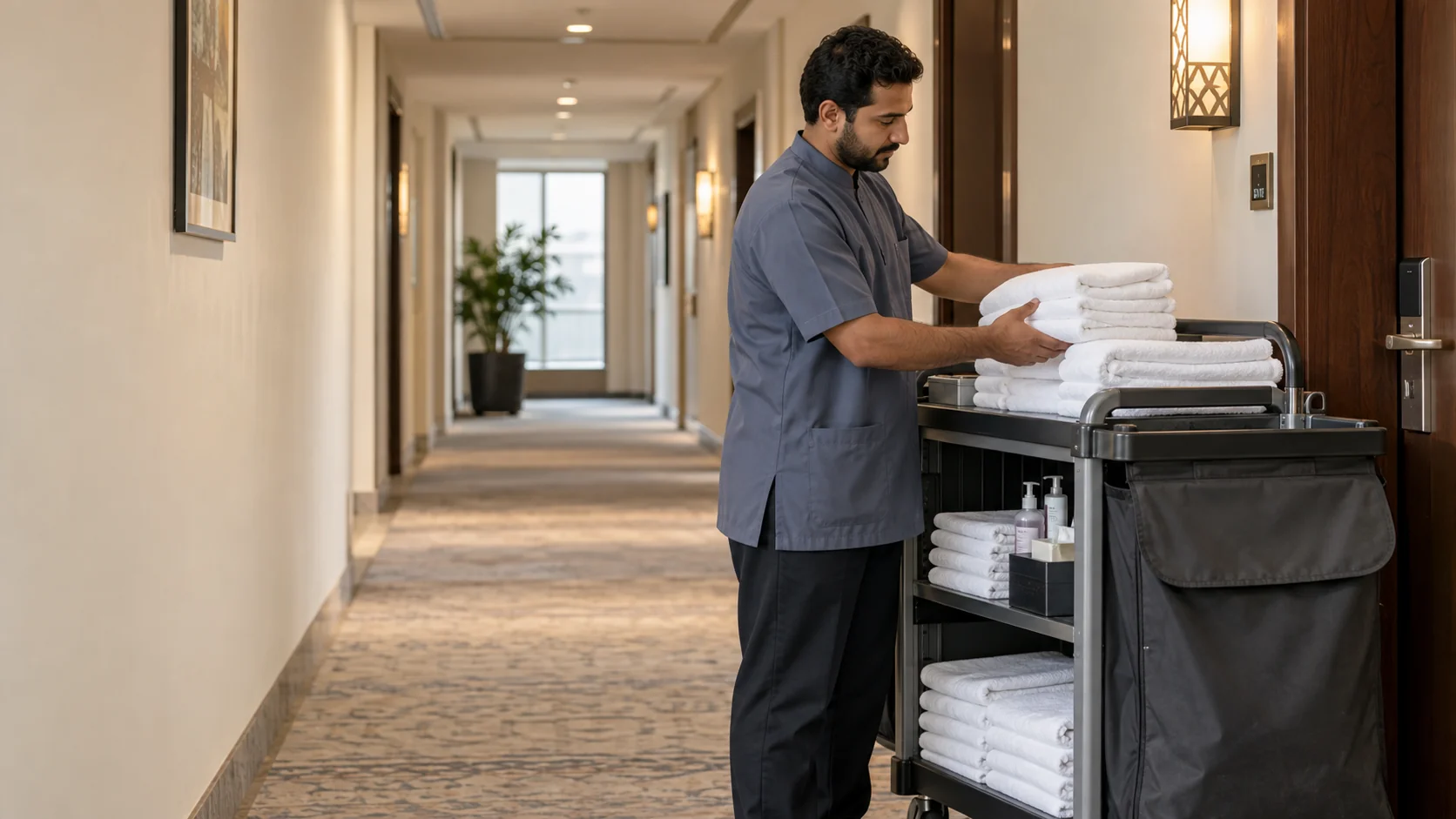
City workforce support
Plan Makkah housekeeping teams around departure rooms, stayovers, group arrivals, linen supply and inspected room release—not one undifferentiated cleaner headcount.
Employer-facing manpower supply and workforce support for Makkah operations.
A Makkah hotel or accommodation operator needs to distinguish rooms to prepare for new arrivals from occupied-room service and public-area coverage. A single total of cleaners does not show whether those workloads can be completed within the actual access windows. Start with the property layout, room types, departure and arrival pattern, service standard and the supervisor who releases inspected rooms. AL AHAD GROUP receives employer workforce requirements for scope review; this page concerns manpower and recruitment coordination, not a claim that we operate a hotel's housekeeping department. Proposed quantities, commercial terms, lawful eligibility and a joining date require separate confirmation. No named hotel relationship, authority approval or guaranteed availability is represented.
For a property serving visiting groups, ask the accommodation coordinator which departures and arrivals are confirmed, which times can change and when rooms become accessible. Keep routine operations separate from a reviewed Hajj, Umrah or other group-related uplift; the calendar alone does not establish a staffing requirement. A group departure can release several rooms together while another group needs luggage or lobby space. Agree how housekeeping receives updates from front office, who prioritizes a changed room list and what happens when a late checkout compresses preparation time. These are operating scenarios for the employer to verify, not a forecast of occupancy, visitor numbers or future demand. The exact property location and reporting point matter more than a broad promise to cover Makkah.
Room attendants prepare the agreed guest-room areas, handle approved amenities and linen, and report room status. Public-area attendants follow a different route through lobbies, corridors, shared washrooms and other approved areas; do not remove that coverage whenever a room queue grows. Housekeeping supervisors allocate work, inspect completion, record defects and coordinate release with the hotel's responsible team. Linen runners or laundry support may be useful where floor distribution or collection is a real workload, but identify whether washing is on site or handled by another operator. A helper role should have bounded tasks and supervision. Technical maintenance, pest treatment, clinical cleaning, specialist deep cleaning and licensed visitor services are not automatically part of these housekeeping assignments.
For each floor, record departure rooms, stayovers, rooms blocked for maintenance, restricted access and the required ready-by time. Add observed preparation time by room type, replenishment journeys, trolley refill and inspection time. Use a representative service cycle rather than an assumed rooms-per-attendant target. The worksheet should distinguish rooms assigned, prepared, inspected and released; a room is not ready for allocation merely because cleaning has stopped. Record why a room is delayed so the coordinator can resolve access, missing linen or maintenance instead of adding staff to the wrong problem. Do not put guest names, passport details or private room records into an open workforce enquiry. A de-identified workload summary is enough for the initial review.
Agree the clean supply point, floor stock arrangement, trolley loading method, collection route and responsibility for shortages. Separate clean linen and amenities from soiled collection under the property's approved procedure. A room-attendant roster can fail even with sufficient people if the service lift is unavailable or replenishment depends on an unclear handover. For outsourced laundry, identify the receiving contact, expected collection and return windows, and what the hotel does when a delivery is delayed. This page does not prescribe disinfection methods or promise laundry capacity. The employer should specify approved products, equipment, PPE and induction, with specialist requirements reviewed by the appropriate competent team. Count replenishment and handling as work, not as invisible spare time.
Map public-area rounds against actual guest movement and the hotel's access arrangements. Identify shared washrooms, lift lobbies, corridor sections, entrances and back-of-house points that need regular attention. Where group movement changes the route, agree safe work windows and the person who authorizes temporary restriction of an area. Housekeeping staff should not create their own crowd-management or security role. Keep washroom supplies, waste collection and wet-floor controls within the approved method and reporting system. Prayer facilities or other sensitive spaces inside the property need the operator's specific instructions; this is not a claim of access to, or work within, the holy mosque. Inspection should record the service area and exception, not just a blanket daily tick.
Record floors, service hours, access permissions, supervisor coverage and the shift handover point before proposing quantities. Allow for the actual staff reporting route, lift or service-corridor access, induction and employer-provided transport or accommodation arrangements. A temporary peak assignment, continuing monthly roster and phased property opening need different start and end conditions. Review breaks, duty hours and eligibility through the appropriate process rather than treating peak demand as permission to ignore them. Relief staff need the same room-status procedure, floor route and escalation contacts as regular staff. Agree how an absence is reported and how a substitute is reviewed and admitted. Availability, replacement response times and mobilization commitments belong in confirmed terms, not an implied promise on a service page.
Use a supervised practical check based on the employer's real room and equipment. Assess the preparation sequence, approved linen handling, room-status reporting and response to a maintenance defect or an inaccessible room. A fast demonstration that leaves an unresolved defect does not establish readiness for release. Supervisors should show how they inspect, identify rework and give a clear shift handover. Review communication needs according to the actual instructions and guest-facing boundary; do not infer capability from nationality or a prior job title. Candidate identity, work history, role documents and lawful eligibility need their own review. A trial confirms only what was observed under its conditions, not a certification, an authority approval or a guaranteed future performance level.
A reviewable requirement connects each role with its workload, selection evidence and mobilization responsibilities. Send the exact Makkah property location, room and floor summary, departure/stayover pattern, public areas, operating hours, desired duration and proposed quantities if assessed. Name the room-release owner, supervisor and employer contact. Identify who supplies uniforms, PPE, tools, consumables, food where required, transport, accommodation and site passes. Explain the laundry arrangement and any specialist work excluded from the request. A common scope helps an employer identify missing assumptions before commercial commitments are discussed. Submit operational needs without unnecessary guest or employee data.
Use observed room preparation and inspection time, room types, departure/stayover mix, access, linen journeys and public-area responsibilities. There is no universal rooms-per-worker ratio in this guide.
Do not assume the scopes are interchangeable. Clinical environments require a separately defined method, site induction, competence and risk review; a hotel assignment does not establish that capability.
Only if the reviewed scope assigns them. Identify whether staff handle linen distribution, laundry operations or only room service, and who owns equipment, products and maintenance.
No. It starts scope review. Confirm the property, roles, eligibility, access, supervisor readiness, commercial terms and availability before treating a date or quantity as agreed.
AL AHAD GROUP JOB SEEKER UPDATES
Follow the AL AHAD GROUP Saudi job channel for vacancy announcements and practical job-seeker guidance. Following the channel does not guarantee shortlisting, selection, visa processing or employment.
 Open channel